
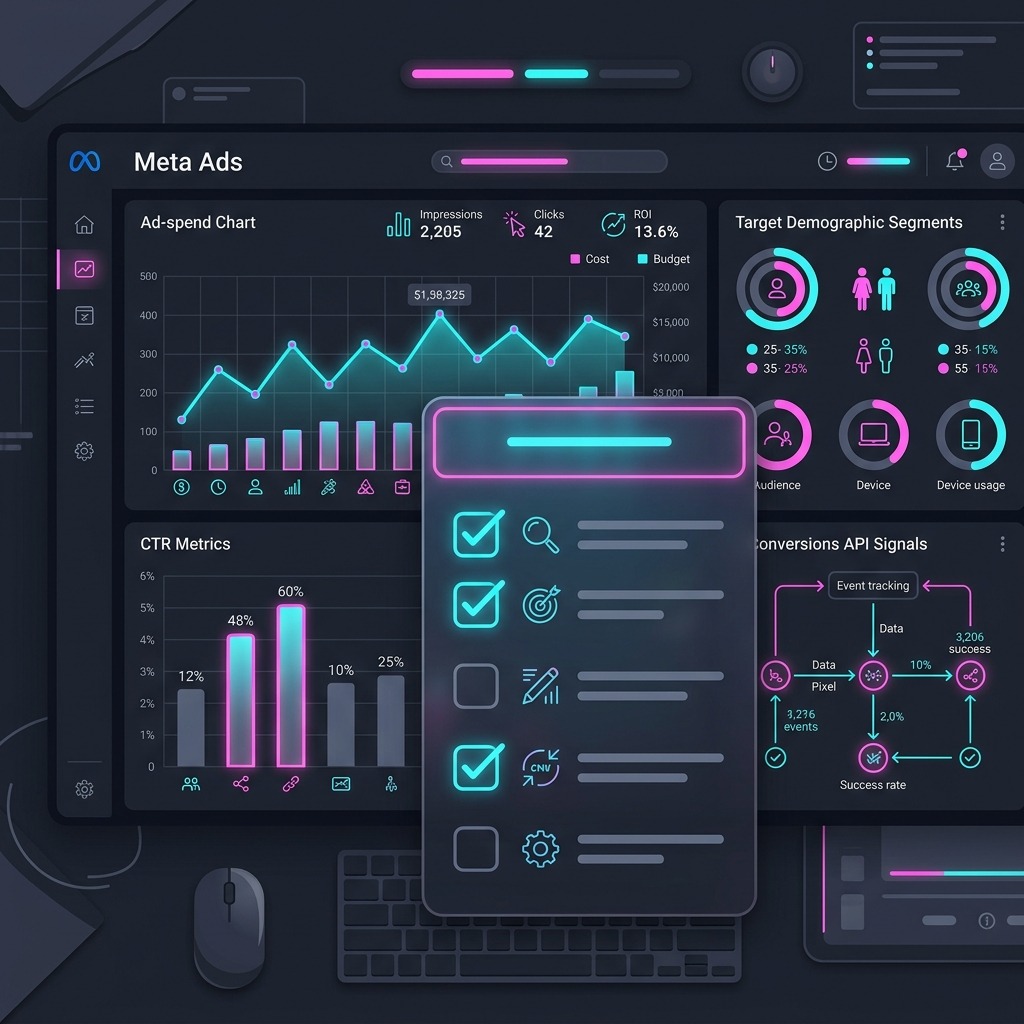
Running paid social campaigns without a regular audit is like driving with your eyes closed. Many advertisers waste thousands of dollars due to broken tracking pixels, overlapping target audiences, and creative asset fatigue that degrades campaign return on ad spend (ROAS). If you want to scale your campaigns profitably, you must conduct a structured review of your setup. This guide provides the ultimate meta ads account audit checklist 2026, detailing the technical configurations, Conversions API tracking verification, and campaign architecture needed to optimize your budget and scale performance.
Table of Contents
- Why a Meta Ads Audit is Critical in 2026
- The 7-Step Meta Ads Account Audit Checklist 2026
- 1. Pixel & Conversions API (CAPI) Integration Audit
- 2. Campaign Architecture & Budget Strategy (CBO vs. ABO)
- 3. Audience Overlap & Bid Cannibalization Cleanup
- 4. Advantage+ Shopping Campaigns (ASC) Structure Review
- 5. Creative Asset Hook Rate & Fatigue Audit
- 6. Lead Quality & CRM Synchronization Audits
- 7. Attribution Windows and Offline Event Uploads
- Technical Guide: Auditing Conversions API Match Quality
- Frequently Asked Questions (FAQs)
- Conclusion
Why a Meta Ads Audit is Critical in 2026
The landscape of social advertising has shifted from manual audience configuration to automated, creative-led machine learning. Meta’s algorithms have become incredibly efficient at finding buyers, but they require clean data inputs and clear performance guardrails to optimize effectively. If your account contains redundant tracking codes, conflicting conversion events, or poor quality creative assets, the machine learning models will make incorrect decisions, leading to rising customer acquisition costs (CAC). To understand how the targeting algorithm locates your buyers, read our guide on how the Meta Ads algorithm works.
An audit allows you to identify where ad spend is being wasted and where tracking gaps exist. In 2026, data loss from browser privacy updates makes server-side tracking a mandatory technical requirement rather than an optional setting. By auditing your account setup weekly, you can correct attribution issues, clean up bid cannibalization, and redirect your budget to high-converting creative concepts. This optimization process forms the foundation for scaling your advertising efforts successfully.
The 7-Step Meta Ads Account Audit Checklist 2026
Securing your paid social acquisition pipeline requires checking both your technical tracking setups and your campaign structures. Use this comprehensive meta ads account audit checklist 2026 to review your account configurations, identify budget leakage, and align your bidding strategy with actual business revenue:
1. Pixel & Conversions API (CAPI) Integration Audit
Every modern Meta Ads account must use a dual-setup: client-side tracking (Meta Pixel) and server-side tracking (Conversions API). If you only use client-side tracking, ad-blockers and privacy settings can block up to 30% of your conversion data. Audit your event deduplication settings inside Event Manager to verify that server events are correctly matched with pixel events using identical event_id parameters. This ensures Google and Meta ad platforms receive accurate purchase values, helping smart bidding algorithms target high-value buyers. Review our Meta Ads strategy guide to learn more about setting up these data signals.
2. Campaign Architecture & Budget Strategy (CBO vs. ABO)
A cluttered account structure with dozens of active campaigns leads to budget fragmentation and slow algorithmic learning. Audit your campaigns to ensure they are consolidated. Use Campaign Budget Optimization (CBO) for your standard evergreen campaigns, allowing Meta’s algorithm to distribute budget to the best-performing ad sets in real time. Reserve Ad Set Budget Optimization (ABO) for testing new creative concepts or specific regional audiences where you want to control the exact ad spend allocation. For cost reference, check out our guide on Facebook ads cost in India.
3. Audience Overlap & Bid Cannibalization Cleanup
If you run multiple ad sets targeting similar audiences (e.g., broad interest, lookalikes, and retargeting) in the same auction, your campaigns will compete against each other. This is known as audience overlap, and it drives up your CPMs and CAC. Use the Audience Overlap Tool inside Business Manager to check overlap percentages between your target lists. If the overlap exceeds 20%, consolidate those ad sets into a single broad target group to improve delivery efficiency and lower costs.
4. Advantage+ Shopping Campaigns (ASC) Structure Review
Advantage+ Shopping Campaigns (ASC) use automation to streamline D2C sales, but they require careful management. Audit your ASC campaigns to verify you have set a strict limit on existing customer budgets (typically under 10% to 15%). If you do not limit retargeting, the algorithm will spend your budget showing ads to repeat buyers, inflating your ROAS while failing to acquire new customers. To understand the strategic role of ASC in modern e-commerce growth, read our guide on Meta Advantage+ campaigns for e-commerce.
5. Creative Asset Hook Rate & Fatigue Audit
In creative-first targeting, your creatives do the targeting. Audit your creative performance by calculating the Hook Rate (3-second video views divided by impressions) and the Hold Rate (15-second video views divided by impressions). A Hook Rate below 30% indicates that your ad’s opening hook is not engaging the audience. A Hold Rate below 10% means your content is failing to maintain interest. Regularly refresh underperforming hooks and visual formats to avoid creative fatigue, which causes CTR to drop and CPC to spike.
6. Lead Quality & CRM Synchronization Audits
For lead generation campaigns, getting high volumes of cheap leads is useless if they do not convert into paying customers. Audit your lead quality by integrating your CRM (e.g. HubSpot or Salesforce) with your Meta Ads account. Track the conversion rate from raw lead to qualified lead. If you notice high volumes of fake phone numbers or invalid emails, update your lead form settings. Use custom questions, require manual typing rather than autofill, or use the “Rich Creative” form type to filter out low-intent users.
7. Attribution Windows and Offline Event Uploads
Ensure you are using the correct attribution window for your business model. The standard 7-day click and 1-day view attribution window works well for impulse-buy D2C products. However, for high-ticket items or long sales cycles, you should implement Offline Conversions. Export sales data from your CRM and upload it to Meta weekly. This offline data attribution closes the loop on offline sales, training the algorithm to target high-value buyers and improving your long-term ROAS.
Technical Guide: Auditing Conversions API Match Quality
To ensure that server-side conversions are matched with real Facebook profiles, you must maximize your Event Match Quality (EMQ). Below is an example of a JSON payload structure sent from a Python server container to the Meta Conversions API. For complete implementation details, review the official Meta Conversions API Developer Guide.
{
  "data": [
    {
      "event_name": "Purchase",
      "event_time": 1718446200,
      "event_id": "order_123456",
      "event_source_url": "https://paidmediaworld.com/checkout",
      "action_source": "website",
      "user_data": {
        "em": "f660ab912ec121d1b1e928a0bb4bc61b15f5ad44d5efdc4e1c92a25e99b8e44a",
        "ph": "4509a25e99b8e44af660ab912ec121d1b15f5ad44d5efdc4e1c92a25e99b8e44a",
        "client_ip_address": "192.168.1.1",
        "client_user_agent": "Mozilla/5.0 (Windows NT 10.0; Win64; x64)"
      },
      "custom_data": {
        "value": 1500.00,
        "currency": "INR"
      }
    }
  ]
}
To ensure GDPR and privacy compliance, all personal identifiers (like emails and phone numbers) must be hashed using SHA-256 before being sent to the Meta servers. Providing multiple matched customer keys – including hashed emails, hashed phone numbers, IP addresses, and user agents – increases your Event Match Quality score. A high EMQ score (above 8.0 out of 10) ensures that conversions are matched with the correct user profiles, improving ad delivery and reporting accuracy. Learn more about Pixel implementation details at the official Meta Pixel Help Center.
Frequently Asked Questions (FAQs)
1. What is a Meta Ads account audit?
A Meta Ads account audit is a comprehensive review of your ad account’s tracking configurations, campaign structures, target audiences, and creative assets. The goal is to identify ad spend waste, tracking gaps, and optimization opportunities to improve campaign ROAS.
2. Why is Conversions API (CAPI) required for Meta Ads?
Browser privacy updates and ad-blockers can block client-side cookies, causing up to 30% of conversion events to go unrecorded. Conversions API passes purchase and lead data directly from your server to Meta, ensuring 100% data tracking accuracy.
3. How do I fix audience overlap in Meta Ads?
If you identify high audience overlap (above 20%) between different ad sets, you should consolidate them into a single broad targeting set. This consolidates conversion data, allows the algorithm to learn faster, and lowers your overall CPMs.
4. What is the Hook Rate in video ad creatives?
The Hook Rate is a metric calculated by dividing 3-second video views by total impressions. It measures how effectively your video’s opening hook captures user attention. A healthy target Hook Rate for paid social campaigns is 30% or higher.
5. What is the difference between ABO and CBO?
Campaign Budget Optimization (CBO) distributes your budget dynamically across all ad sets in a campaign to maximize results. Ad Set Budget Optimization (ABO) allows you to set explicit budget limits for each ad set, which is ideal for creative testing.
Conclusion
Conducting regular account audits is the only way to scale paid social campaigns and protect your ad budget. By implementing the steps in this meta ads account audit checklist 2026 – from verifying pixel deduplication and CAPI match quality to consolidating overlapping ad sets and monitoring video hook rates – you can build a highly efficient marketing funnel. Set aside time every month to review your settings, clean up old campaigns, and focus your ad spend on high-converting assets to drive business revenue.


Leave a Reply